
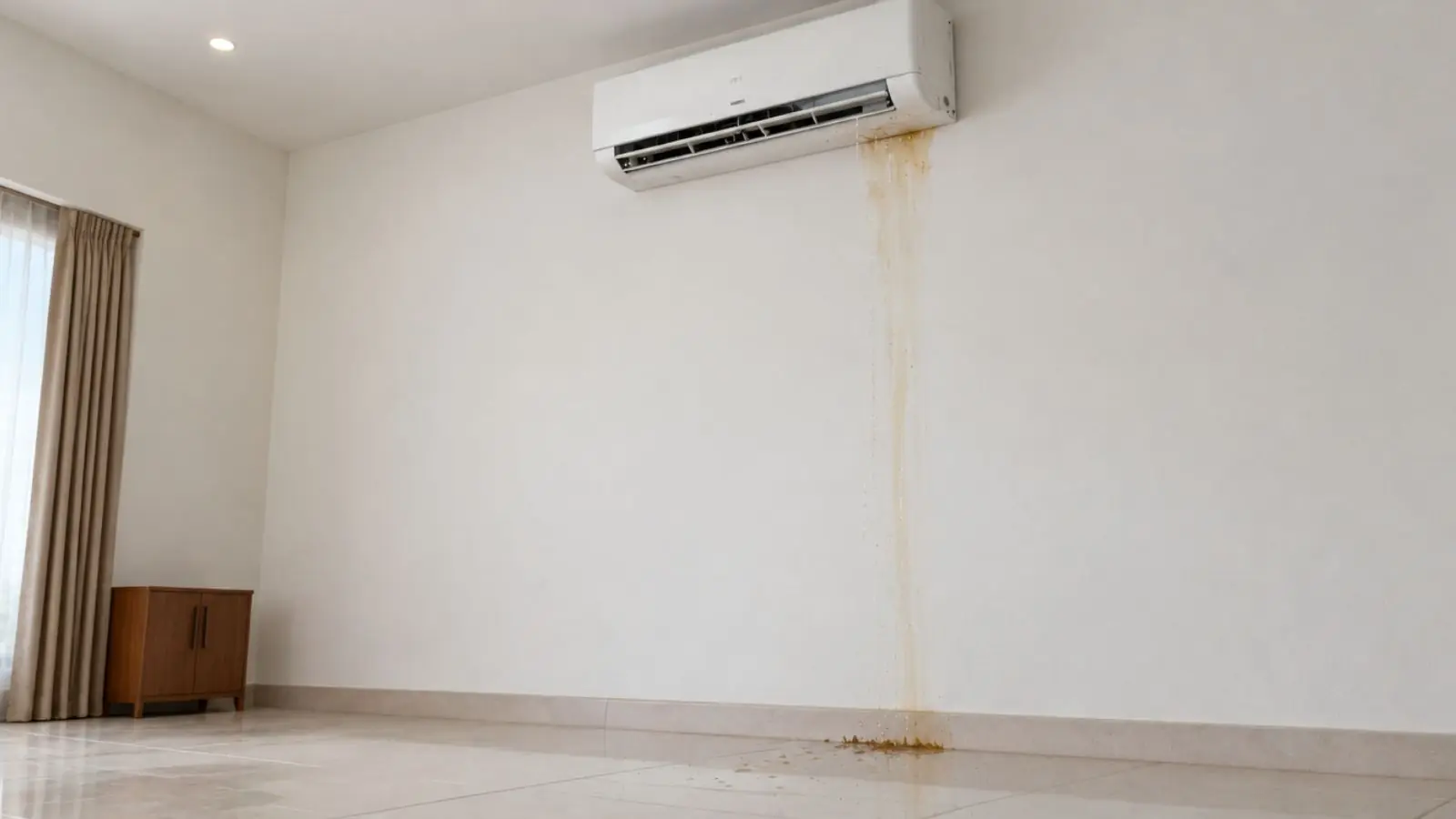
AC leak water damage in West Hollywood, CA is moisture from an air conditioner's condensate system that has escaped into a ceiling, wall, closet or floor. Cooling coils pull water out of the air, and that water is meant to run through a drain line to a safe spot. When the line clogs, the pan cracks or a coil ices over and melts, the water goes somewhere else.
Be realistic about how common this is here. Many older West Hollywood apartments have no central air, so the cases we see involve ductless wall units, ceiling cassette units in multifamily and commercial spaces, or air handlers in a closet or attic. If none of those describe your building, the cause is probably something else, and water damage repair covers the rebuild once the source is found.
How an AC leak starts in West Hollywood buildings
The City of West Hollywood's 2023 hazard mitigation plan says most homes are small houses and duplexes from the 1920s, with some seven and eight story apartment buildings from the 1920s and 1930s, and that many buildings predate 1993. Cooling was added to those buildings later, often through old chases and ceilings. Long condensate runs with little slope clog easily.
Climate matters too. NOAA 1991 to 2020 normals for the Westwood station show only 0.03 inch of rain in July and 0.01 inch in August, while February averages 4.73 inches. A ceiling stain that appears in a dry summer month rarely comes from the roof. It is far more likely a plumbing line, an appliance or an AC condensate problem.
Signs the air conditioner is the source
- A stain, drip or sagging patch on a ceiling below or beside an air handler or cassette unit.
- A rust colored or damp streak down the wall under a ductless wall unit.
- A musty smell near a closet or attic hatch that holds the air handler.
- A drain pan that is full or overflowing while the unit runs.
- Ice on the coil or lines, followed by dripping after the unit shuts off.
- A stain that grows only on hot days when the unit runs for hours.
A leak that tracks the unit's run time points to condensate. A leak that appears with rain, or day and night regardless of the unit, points elsewhere and needs a plumber or roofer to trace it.
| Unit type | Common leak point | What we check |
|---|---|---|
| Ductless wall unit | Clogged drain hose or a unit mounted off level | The wall behind and below the unit |
| Ceiling cassette | Drain pan or condensate pump | Ceiling tiles, insulation and the floor below |
| Closet or attic air handler | Secondary pan or drain line | The ceiling beneath, closet floor and baseboards |
| Iced coil | Melt water overflowing the pan | Nearby framing and insulation |
Every job starts with finding where the water went, not only where it came from.
First-hour safety steps
Turn the unit off at the thermostat or remote so it stops making water. If the unit has its own switch or breaker and you can reach it from a dry spot, switch it off there. Do not touch a unit or an outlet while standing in water.
Move furniture and rugs out from under the drip, set out a bucket and photograph the unit, the stain and any standing water. If a ceiling is bulging, stay out from under it, because trapped water is heavy. Call the 24/7 line, and renters should tell the manager the same day.
Our process on the water side
Find the wet area
A moisture meter and a thermal imaging camera show how far water traveled past the visible stain.
Dry the cavity
Air movers and small dehumidifiers dry the ceiling or wall cavity, with openings made only where readings call for them.
Remove what cannot dry
Wet insulation and soft drywall are cut out and bagged.
The unit and its drain line belong to an HVAC technician. We do not repair air conditioners. We handle the water side and hand the space back dry so the technician and the painter can finish. For how water categories and drying goals are described, we point to ANSI/IICRC S500.
The City of West Hollywood's Building and Safety FAQ says a mechanical permit covers installing or repairing comfort cooling equipment, and replacing a component that does not change the original approval is exempt. Ask your HVAC contractor which applies to your repair.
Water coming from an AC unit?
Call the 24/7 line. We explain what to switch off while a crew is dispatched.
What changes the cost of AC leak cleanup
- How long the line leaked before anyone noticed.
- Whether water reached insulation, drywall, flooring or the unit below.
- Ceiling height and access, including attics and tight closets.
- Whether mold growth has started and needs its own scope.
- How many units or rooms share the wet area, which affects coordination.
How insurance usually fits
Policies often treat a sudden overflow differently from a slow drip that ran for months, so read the wording before you assume anything. Call your insurer early and keep photos, receipts and a log of calls. The California Department of Insurance claims guide advises making temporary repairs to protect the property and keeping that log. Renters should ask the manager how the building's policy handles it.
Mistakes to avoid and prevention
- Running the unit while water is dripping, which keeps feeding the leak.
- Painting over a stain before the cavity behind it is dry.
- Pouring cleaners into the drain line without asking the HVAC technician.
- Skipping drain line cleaning and pan checks before the hot months.
- Ignoring a small stain, since a slow leak can wet insulation for weeks.
Dry months, wet ceilings
About four in five occupied homes in West Hollywood are rented, according to the 2020 Census. In a rental, one unit's air conditioner can soak a neighbor's ceiling, so tell the manager early and photograph the unit and the stain before anything is moved.
Because rain is nearly absent from June through September in the NOAA normals, a summer ceiling stain deserves a look at the cooling equipment first. In mid-rise buildings the water often runs along a pipe chase or light fixture to a lower floor, so check there too.
Sources: 2020 U.S. Census, NOAA 1991 to 2020 normals (Westwood station) and City of West Hollywood Local Hazard Mitigation Plan (2023).
AC leak questions from West Hollywood
Is emergency ac leak water damage available in West Hollywood?
Yes. The 24/7 line takes calls at night and on weekends, and a crew is dispatched when one is available. No arrival time is promised. Turn the unit off and keep water away from outlets while you wait.
Will you repair the air conditioner?
No. An HVAC technician repairs the unit, the pan and the drain line. We dry and clean the water damage and coordinate timing so the wet area is not closed up before it is dry.
Can a small AC leak cause mold?
It can when the cavity stays damp. The EPA advises drying wet materials in 24 to 48 hours, and a ceiling cavity that stays wet longer may need a look from mold remediation.
I rent. Who do I call first?
Tell the property manager right away, take photos and call us if water is still spreading. The service area page lists the neighborhoods we cover.
How do I know the stain is from the AC and not a pipe?
Timing helps. A stain that grows only while the unit runs points to condensate, while a steady drip day and night points to plumbing, which a plumber needs to trace.
Do you serve Beverly Hills too?
Yes. The Beverly Hills page lists the ZIP codes served and the local permit counter.